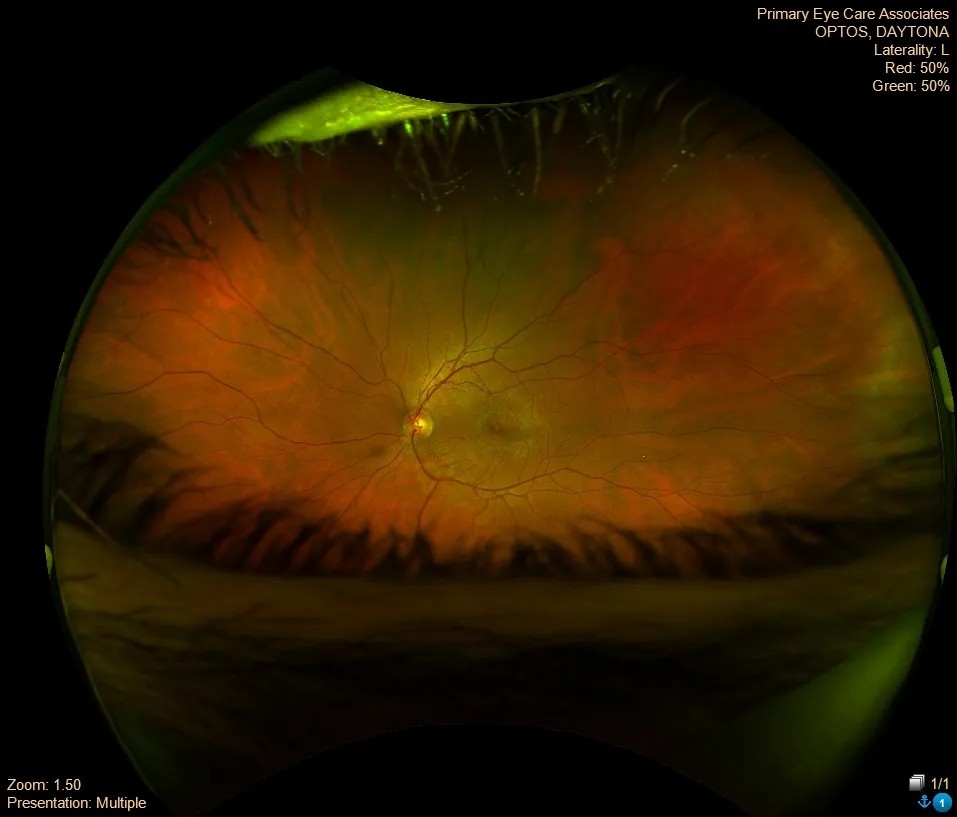
Abstract. Direct solar veneration is among the oldest religious gestures on Earth. Direct ocular fixation on the solar disk is a different act, with a different evidentiary record. This expanded essay keeps the Sungazing Protocol intact, then reconstructs solar rites across civilizations, the modern genealogy of timed sungazing, the clinical literature on solar retinopathy, atmospheric optics of the horizon path, the neuroscience of non-image-forming vision, and a theory of light as code—a structured message written in intensity, spectrum, timing, and place of origin. The pineal gland is treated first as an endocrine organ with a measurable calcification literature, then as the site of older philosophical claims and of still-open experimental questions. Controlled photobiomodulation, optogenetic vision restoration, and cortical and subretinal prostheses are reviewed as technologies that already write with light. Scripture is read comparatively. The argument is not that looking at the sun is safe. It is that first light is a timestamp, and a timestamp can be received without burning the channel that reads it.
IHow to read this essay
Three practices are routinely fused in popular writing. They should be kept apart.
- 1. Solar veneration — hymn, prostration, offering, calendar rite, temple alignment. The body faces the rising or setting sun. The eyes may be lowered, half-closed, or directed toward the horizon. The act is religious or civic.
- 2. Dawn and dusk exposure — standing outdoors in early or late light, often barefoot, without fixing the fovea on the disk. This is the photobiologically interesting practice: melanopsin-containing retinal ganglion cells sample ambient irradiance and deliver the day’s primary temporal cue to the brain.
- 3. Direct sungazing — steady foveal fixation on the solar disk. This is the practice that produces case reports of solar retinopathy. It is also the practice marketed in the late twentieth century as a health protocol.
Ancient cultures abundantly attest (1). They moderately attest outdoor dawn observance that resembles (2). They do not provide a clean, continuous, medically documented lineage for (3) as a universal “safe” therapy. Claims that “the Egyptians stared at the sun for health” or that Hatha Yoga Pradīpikā prescribes forty-four minutes of solar fixation are over-readings. A serious history can honor solar religion without laundering a modern protocol into the Bronze Age.
This essay therefore keeps two registers of argument — historical and clinical. Where they disagree, the disagreement is stated.
Two further distinctions keep the later sections honest.
Reading light versus writing with light. The eye is a reader. Photobiomodulation devices, optogenetic vectors, and photovoltaic retinal chips are writers. They specify wavelength, dose, and target tissue. The sun specifies none of those at the fovea.
Established claim versus open hypothesis. A later section treats pineal calcification, endogenous tryptamines, and tests now running. That material is written in the same voice as the rest of the essay. It is marked, in place, as correlational, animal-limited, unpublished in humans, or prospective. A reader who wants only the closed file can stop before that section.
IIWhere it started: solar religion is older than any single “method”
No culture “invented the sun.” What cultures invented were names, rites, and architectures that made the daily return of light intelligible.
Egypt
From the Old Kingdom onward, Re (Ra) was not a side-deity. He was the daytime face of cosmic order. Heliopolis (Iunu) was a solar city whose priesthood supplied the dominant cosmogony of the Pyramid Age: Atum-Re generates the Ennead, and the king is the living son of Re (Assmann, The Search for God in Ancient Egypt; Quirke, The Cult of Ra). Pharaohs of the Fourth and Fifth Dynasties built sun temples as well as pyramids; the Fifth-Dynasty Abusir complex (Userkaf, Niuserre) is architecture for a daily solar liturgy, not for staring at a disk as therapy (Wilkinson, The Complete Temples of Ancient Egypt). In the Eighteenth Dynasty, Amenhotep IV / Akhenaten concentrated worship on the Aten, the visible disk, whose rays end in hands. Open courts at Amarna and east-facing rites made seeing the disk rise a liturgical act (Hornung, Akhenaten and the Religion of Light; Kemp, The City of Akhenaten and Nefertiti). Hymns from the Amarna period—especially the Great Hymn to the Aten from Ay’s tomb (EA 25)—and solar hymns in the Book of the Dead (spell 15) praise the god who “rises on the horizon” and whose “splendour falls upon the body.” That is exposure and adoration. It is not an ophthalmologic protocol.
Egyptian medicine, moreover, produced the first named specialist in eye disease. The tomb of Pepi-ankh / Iri at Tushka and related Sixth-Dynasty titles name a “palace oculist,” and the Ebers Papyrus (c. 1550 BCE, copying older material) devotes a substantial section to diseases of the eye, with prescriptions for trachoma-like inflammation, cataract-like clouding, and trauma (Nunn, Ancient Egyptian Medicine; Ghalioungui, The House of Life). A civilization that appointed court oculists and wrote a pharmacopoeia for the orbit is unlikely to have been indifferent to ocular injury. Claims that “the Egyptians stared at the sun for health” collapse against this file. They watched the sun as kingship and maat. They treated the eye as a vulnerable organ.
The Eye of Re / Wedjat is a separate and fertile symbol: the sun as an organ of seeing, the eye as an agent that can wander, burn, and be restored (Pinch, Egyptian Mythology; Ritner, The Mechanics of Ancient Egyptian Magical Practice). In the myth cycle the solar eye leaves, rages as Sakhmet, and is pacified and returned; the wedjat amulet is a restored fraction, not a license to overload the retina. Light here is not only illumination. It is sovereignty and surveillance. Assmann’s reading of New Kingdom solar religion (Egyptian Solar Religion in the New Kingdom) is precise on this point: the god sees, and being seen by the god is a political-theological condition.
Temple orientation supplies the archaeological control. East-west axes at Karnak, the solstitial alignment argued for the Great Temple of Amun, and the open solar courts of the Aten temples are about the path of the disk across a built horizon (Hawkins’s Karnak claim is debated; later work by Krupp and by Belmonte and Shaltout, In Search of Cosmic Order, is more cautious and more useful). Priests timed offerings to sunrise because the god arrived then. The liturgical act is greeting, censing, and recitation at first light. No surviving medical or ritual papyrus specifies seconds of foveal fixation on the disk as a cure for disease.
What can be said without over-reading: Egypt gives the densest early archive of solar theology, solar kingship, and ocular medicine in the same civilization. Re is the daytime face of order. The Aten episode is the most radical “visible disk” cult in the Bronze Age. The oculist title and the Ebers eye chapters show that injury to sight was already a named specialty. That combination is the historical point. It is also the limit. Amarna hymns do not become a Bates protocol by quotation.
Mesopotamia
Utu (Sumerian) / Shamash (Akkadian) is judge because he sees. Dawn is the opening of the gates of heaven. Law and visibility are the same metaphor (Jacobsen, The Treasures of Darkness; Bottéro, Religion in Ancient Mesopotamia). Sippar (ancient Zimbir) was a cult center of the solar disk; the Ebabbar, “White House,” was Shamash’s temple, excavated in campaigns from Rassam through the Iraqi and British work of the twentieth century. The god who “illuminates the regions” is morally all-seeing, not a dietary supplement.
The visual evidence is unusually explicit. On the Law Stele of Hammurabi (Louvre, Sb 8; eighteenth century BCE) Shamash, seated, extends rod and ring to the king. The prologue names the king as the one called by Shamash “to rise like the sun over the black-headed people and to light up the land.” Justice is a lighting. The same iconography of rod and ring appears on other solar and royal monuments (Slanski, “The Babylonian Entitlement narûs”). None of it is a staring drill.
Hymnic literature confirms the codebook. The Great Hymn to Shamash (Lambert, Babylonian Wisdom Literature) praises the god who “sees the plots of the wicked” and who crosses the sky as a daily audit. Night prayers ask the gods of the night to keep watch until Utu opens the eastern gate (Horowitz, Mesopotamian Cosmic Geography). Diviners read the liver and the sky because the world was assumed to be legible; solar omens in Enūma Anu Enlil treat eclipses and disk-color as messages about kingship, not as phototherapy (Rochberg, The Heavenly Writing).
Medicine in the same archive is again a check on modern projection. Diagnostic and therapeutic tablets (Geller, Ancient Babylonian Medicine; Scurlock and Andersen, Diagnoses in Assyrian and Babylonian Medicine) name eye diseases, night-blindness-like complaints, and trauma. Shamash may be invoked as a healer because he sees the hidden cause. That is theodicy, not a protocol of foveal loading. The person who needs the sun-god’s help with the eyes is a patient, not a sungazer.
Origin, for this region: Mesopotamia contributes the strongest ancient identification of sunlight with legal knowledge. Utu/Shamash is the eye of the day. The gates of dawn are a bureaucratic and cosmic opening. Timed health-sungazing is not in the tablets. What is in the tablets is already enough: light as the condition of judgment.
Iran and the Roman East
Vedic Mitra and Avestan Mithra share a solar-adjacent, covenant-keeping character. In the Rigveda (3.59 and related hymns) Mitra is the friend, the contract, the one who “looks upon the peoples with an unwinking eye.” In the Avesta, Yasht 10 (Mihr Yasht) gives Mithra a thousand ears and ten thousand eyes; he is not originally the disk itself but the guardian of oath who is later drawn into solar imagery (Boyce, A History of Zoroastrianism; Malandra, An Introduction to Ancient Iranian Religion). Zoroastrian liturgy faces a source of light—fire, the sun—because asha is visibility. Again: orientation, not foveal fixation.
In the Roman Empire, Sol Invictus and Mithraic cult made the unconquered sun a military and imperial emblem. Aurelian’s temple of Sol on the Campus Agrippae (dedicated 274 CE) and the later placement of 25 December among imperial solar observances are calendar politics (Halsberghe, The Cult of Sol Invictus; Hijmans, Sol: The Sun in the Art and Religions of Rome). East-facing shrines and the natalis of the unconquered sun organize time and loyalty around the disk. They do not prescribe staring into it.
The Mithraic evidence is archaeological and iconographic, not medical. Mithraea are caves or cave-like rooms with a tauroctony: Mithras killing the bull, torchbearers Cautes and Cautopates as rising and setting light, a zodiac, often Sol and Luna in the corners (Clauss, The Roman Cult of Mithras; Beck, The Religion of the Mithras Cult in the Roman Empire). Beck’s reading of the cult as a “star-talk” initiatic astronomy is the most careful recent account: the initiate is taught a map of the sky. Ulansey’s older “Perseus and the precession” thesis is no longer the consensus and is cited here only as a caution against one-code decipherments. Nothing in the grade structure (Corax to Pater) is a timed solar stare.
Iranian fire-temple practice and later Parsi facing of the sun at the kusti prayers keep the same grammar: light as witness of truth. Mary Boyce stressed that Zoroastrians do not worship the fire or the sun as the god, but pray in their presence (Zoroastrians: Their Religious Beliefs and Practices). Roman soldiers who initiated into Mithras were not being issued an ophthalmologic ladder of seconds. They were being issued a cosmos in a room.
The comparative yield is narrow and solid. Across Vedic Mitra, Avestan Mithra, Roman Mithras, and Sol Invictus, light is covenant, victory, and the daily return of order. December festivals, east-facing shrines, and “unwinking eye” epithets are about being seen by the day. They are not a missing link to Hira Ratan Manek.
India
This is the densest textual field.
Vedic hymns address Sūrya, Savitṛ, Mitra, Pūṣan, Vivasvat, and the Ādityas. The sun is “the eye” of the gods and of the world (Rigveda 1.164.4 and related solar hymns). The Gāyatrī mantra (Rigveda 3.62.10), later prefixed with the mahāvyāhṛtis bhūr bhuvaḥ svaḥ, is a prayer that the radiance of Savitṛ illumine the intellect—dhiyo yo naḥ pracodayāt. That is the oldest and most important Indic statement of light as cognitive information, not as calories.
The Sūrya Upaniṣad, a later Atharvan text in the Muktika list, identifies Āditya with the inner organ, the breaths, the senses, and Brahman, and says “divine Savitṛ is our eye.” The Ādityahṛdayam in the Yuddha Kāṇḍa of the Vālmīki Rāmāyaṇa is Agastya’s hymn to Rama before the last battle: the sun as Brahmā, Viṣṇu, Śiva, time, and the witness of the worlds—lokasākṣin. Both texts treat the sun as the self of the moving and the unmoving. Neither is a timed stare protocol.
The Bhagavad Gītā (4.1–2) places the transmission of yoga in a solar lineage: Krishna taught it to Vivasvān, the sun, who taught Manu, who taught Ikṣvāku. The point is royal and metaphysical succession, not ocular technique. The Īśa Upaniṣad (15) asks Pūṣan to remove the golden disk that covers the face of truth so that the lover of truth may see. The disk there is a veil, not a target.
Sectarian sun worship (Saura) is visible in the Mahābhārata, in Purāṇic vratas, in the Sāmba and Bhaviṣya Purāṇas, and in the Saurasaṃhitā, an early surviving tantra of sun worship (manuscript tradition dated to the tenth century CE). Maga priests from the Iranian world are traditionally credited with shaping north-Indian solar cult. The temple at Konark is architectural theology: a stone chariot of the sun.
What about looking? Travelers from the early modern period describe Indians raising hands toward the sun and prostrating. Sūryanamaskāra as a flowing gymnastic sequence is largely a twentieth-century crystallization—Raja of Aundh (Bhavanrao Pant Pratinidhi) in the 1920s, then Krishnamacharya’s Mysore school—built on older namaskāra and martial vyāyāma. Historians of modern yoga (Singleton, Alter, Sarbacker, Russell) have shown that the popular “ancient sun salute” story is too simple. Older still is sandhyāvandana: dawn and dusk prayer facing the sun, Gāyatrī recitation, water offering. The eyes participate. They are not the instrument of a timed stare.
Trāṭaka is named in the Haṭha Yoga Pradīpikā (c. 15th century) and Gheraṇḍa Saṃhitā (c. 17th). The classical instruction is to gaze at a small mark until tears come. It is a concentration kriyā. Later teachers sometimes include sūrya-trāṭaka at dawn or dusk. That is a late, specialized, and caution-laden branch, not the Vedic default.
The Americas, East Asia, the Mediterranean
Maya and Mexica solar calendrics, Inti in the Andes, Amaterasu in Japan, Helios and Apollo in Greece, the cosmic eye motif in many mythologies (sun and moon as the two eyes of a world-body): the pattern is planetary. Humans treat the brightest object in the sky as ancestor, judge, clock, and eye (Aveni, Skywatchers; Empires of Time). The point of this section is not a world tour. It is to show that solar religion is polycentric, and that none of the well-documented centers hands us a medical stare protocol.
In Mesoamerica the sun is a calendar engine. The Maya 260-day tzolk’in and 365-day haab’, the Long Count, and E-group architectural complexes at sites such as Uaxactún track solstice and equinox sunrises as civic time (Aveni, Stanton, and colleagues; Milbrath, Star Gods of the Maya). Mexica theology makes Tonatiuh the fifth sun, fed by sacrifice so that the day continues (Sahagún, Florentine Codex, Book 7). Alignment of the Templo Mayor toward equinoctial sunrise is argued on archaeological grounds (Aveni, Calnek, and Hartung). The disk is a hungry clock. It is not a lamp for the macula.
In the Andes, Inti is ancestor of the Inca. Coricancha in Cusco housed the golden disk; the ceque system of shrines radiating from the city has been read as a sidereal and solar calendar (Zuidema; Urton, At the Crossroads of the Earth and Sky). June solstice Inti Raymi, as recorded by colonial witnesses (Cobo; Garcilaso de la Vega, with the usual cautions about mestizo reconstruction), is a state greeting of the returning sun. Horizon astronomy, not foveal loading, is the technique.
In Japan, Amaterasu is the imperial ancestress of the Kojiki and Nihon Shoki. Ise Jingū’s rebuilding cycle and the first-sunrise pilgrimages of hatsuhinode keep solar origin visible in a living state cult (Hardacre, Shinto and the State; Naumann on the solar cave myth). The worshiper faces the rising light. The prescription is purity and timing, not seconds on the disk.
In the Greek and later Mediterranean file, Helios drives the daily chariot; the Colossus of Rhodes was his cult statue. Apollo takes on light, order, and the unerring strike; Burkert (Greek Religion) and Graf caution against collapsing Helios into Apollo too early, but by the Hellenistic period the identification is easy. Plato’s Republic VI–VII puts the sun as the analog of the Good in the visible world: the cause of sight that is not itself the eye. That is already a theory of light as code. It is also already a warning not to confuse the source with the organ. Helios can burn those who fly too near (Ovid’s Phaethon is the popular version of an older caution).
Origin, stated carefully: solar religion is prehistoric and polycentric. Modern timed sungazing as a health system is historically recent, even when it quotes ancient names. The Americas, Japan, and the Greek east give calendars, ancestors, and philosophical suns. They do not give forty-four minutes.
IIIThe modern protocol: Bates, breatharianism, and Hira Ratan Manek
Two twentieth-century streams feed the contemporary practice. Neither is Vedic. Neither is Egyptian. Both are modern, charismatic, and poorly controlled, and both leave a paper trail that can be cited without myth.
William H. Bates (1860–1931), a New York ophthalmologist, published The Cure of Imperfect Sight by Treatment Without Glasses in 1920. “Sunning” was part of a method that rejected conventional refractive optics: patients were told to let sunlight fall on closed lids and, in some instructions, to glance at the sun. Aldous Huxley’s The Art of Seeing (1942) popularized a version of the school. The British Medical Journal’s later summary was blunt: Bates advocated prolonged sun-gazing as a treatment of myopia, “with disastrous results” (BMJ, 1967, 1: 570, in the discussion of the Bates method; see also Pollack, The Truth about Eye Exercises, 1956). Elliott’s review in Ophthalmic and Physiological Optics (2013) finds no reliable evidence that the Bates method reverses refractive error. The American Academy of Ophthalmology and RANZCO treat it as unsupported. The Bates method is not accepted ophthalmology.
A second stream is inedia: the claim that a human being can live on light. Jasmuheen (Ellen Greve) promoted “pranic nourishment”; coroners in the 1990s recorded deaths of followers who attempted to stop eating (Verity Linn in Scotland, 1999; other cases in Australia and Europe reported in contemporaneous press and later summaries in The Skeptic). Inedia is classified as a pseudoscientific claim by medical and skeptical literature. Several breatharian adherents have died of starvation. That file matters because the modern sungazing pitch often borrows its promise: photons as food.
Hira Ratan Manek (1937–2022), a mechanical engineer from Kozhikode, popularized a staged protocol: seconds at first, adding roughly ten seconds a day, only near sunrise or sunset, often barefoot, culminating around forty-four minutes after many months (The Hindu, “The man who consumed the sun is no more,” 2022; contemporaneous interviews archived in Eat the Sun, dir. Peter Sorcher, 2011). He claimed that solar gazing could reduce food need, calm the mind, and “activate” the brain. He and supporters described long fasts (211 days; 411 days) and alleged observation by Indian physicians and, in retellings, by NASA or American universities. Those institutional claims have been denied or left unpublished in the form required to count as evidence. NASA does not run a sungazing validation desk. The 2011 documentary Eat the Sun recorded restaurant staff describing Manek eating a full buffet. An ophthalmologist’s review of the film in The Skeptic (UK, 2022) treats the ocular risk as the medical story the film underplays.
Manek matters historically because he standardized the internet protocol. Most English-language “how to sungaze” pages are HRM descendants, not Vedic commentaries: the ten-second ladder, the 44-minute ceiling, the sunrise/sunset window, the barefoot instruction, the pineal claim. That does not make every dawn-stander a fraud. It means the chain of custody for the method is modern, charismatic, and poorly controlled. A practice can be sincere and still have a recent inventor.
Religious and recreational clusters already sat in the clinical literature before the internet ladder. Nix and colleagues (Journal of the Louisiana State Medical Society, 1987) described solar retinopathy after sungazing at Medjugorje. Hope-Ross, Travers, and Mooney (British Journal of Ophthalmology, 1993, and related eclipse papers) mapped festival and eclipse injury. Chen and colleagues (BMJ Case Reports, 2013, PMC3604317) documented sungazing retinopathy in a contemporary patient. The 2024 Clinical Insights in Eyecare case report tied bilateral solar retinopathy in a young patient to the TikTok trend “#SunGazing,” noting tens of millions of views for content that presents staring at the sun as vision-enhancing. Social media did not invent the injury. It scaled the instruction.
What a scholarly history can therefore say, without sneer and without sanitizing: Bates gave sunning a medical costume it did not earn. Breatharianism gave photons a caloric costume they do not wear. Manek gave the English-speaking internet a countable ladder. Ophthalmology gave the outcome measure. The ancient names quoted on those pages belong to the sections above. They are not the method’s source.
IVHow many people practice?
There is no credible world census of sungazers.
What can be said:
- • Sun-facing prayer is enormous. Daily Gāyatrī and sandhyā in Hindu life, fajr prayer timed to dawn in Islam, eastward Christian liturgical orientation, Japanese first-sunrise pilgrimages (hatsuhinode), and indigenous solstice gatherings add up to hundreds of millions of people who orient to solar time every year. That is not sungazing.
- • Sūryanamaskāra as exercise is mass practice in India and global yoga. Guinness has recorded multi-venue sun-salutation events numbering in the thousands at a single coordinated attempt; school and park yoga multiplies that by orders of magnitude. Again: not foveal staring.
- • Direct sungazing communities are small, networked, and invisible to epidemiology. Promotional sites say “thousands.” Ophthalmology journals see sporadic clusters after eclipses, pilgrimages (for example Medjugorje sungazing retinopathy in the 1980s), manic or psychotic episodes, and now social-media challenges. Between the marketing number and the case-report number sits an unknown.
Honest statement: we do not know how many people stare at the sun on purpose. We know the practice is globally distributed, demographically young-skewed online, and medically visible only when it injures.
VClaimed benefits — and what evidence can actually carry
Practitioners report, with striking consistency:
- • a feeling of calm or “charged” mood after dawn standing;
- • easier waking;
- • reduced anxiety;
- • a sense of sacred attention;
- • sometimes reduced appetite (confounded by fasting subcultures).
Some of these reports are compatible with real, non-mysterious physiology that does not require looking at the disk:
Clock resetting. Light, especially in the hours after waking, is the strongest environmental cue that sets the phase of the suprachiasmatic nucleus. Outdoor dawn light is typically far brighter than indoor lighting. People who go outside at sunrise often sleep and mood-regulate better because they received a timestamp, not because photons were metabolized as food.
A quantitative language now exists for that timestamp. The International Commission on Illumination’s standard CIE S 026:2018 defines melanopic equivalent daylight illuminance (melanopic EDI): the illuminance of standard D65 daylight that would produce the same melanopsin-weighted irradiance as the light actually at the eye. An expert consensus (Brown, Phillips, and colleagues, 2022; summarized in CIE TN 015:2023 and the CIE 2024 position statement) recommends, for healthy day-active adults, a daytime minimum of about 250 lx melanopic EDI at the eye, an evening maximum of about 10 lx in the three hours before bed, and a sleep-environment maximum of about 1 lx. Most indoor days fall short of the daytime number. A few minutes outdoors, even under a red-shifted dawn sky, often clears it. That is the benefit hiding inside the ritual.
Behavioral bundle. Bare feet, cool air, quiet, no phone, a nine-minute ritual: this is meditation plus nature exposure plus digital absence. Those variables have independent evidence.
Placebo and expectation are not insults. They are measurable.
What does not have evidence:
- • that the human body can replace meals with solar photons through the pupil;
- • that sungazing enlarges or “decalcifies” the pineal gland in a clinically demonstrated way;
- • that the practice is safe at the durations advertised once the fovea is fixed on the disk;
- • that NASA validated inedia.
The plant analogy (“if leaves can eat light, why can’t we?”) fails at first-year biochemistry. Photosynthesis uses chlorophyll and a membrane architecture humans do not have. Photons that strike the retina are transduced into electrochemical spikes, not into ATP sufficient to run a liver.
VIRisks: the medical literature is not ambiguous
Solar retinopathy is photochemical injury to the fovea, sometimes thermally enhanced. The retina has no pain receptors. Injury can occur before the person feels that anything is wrong.
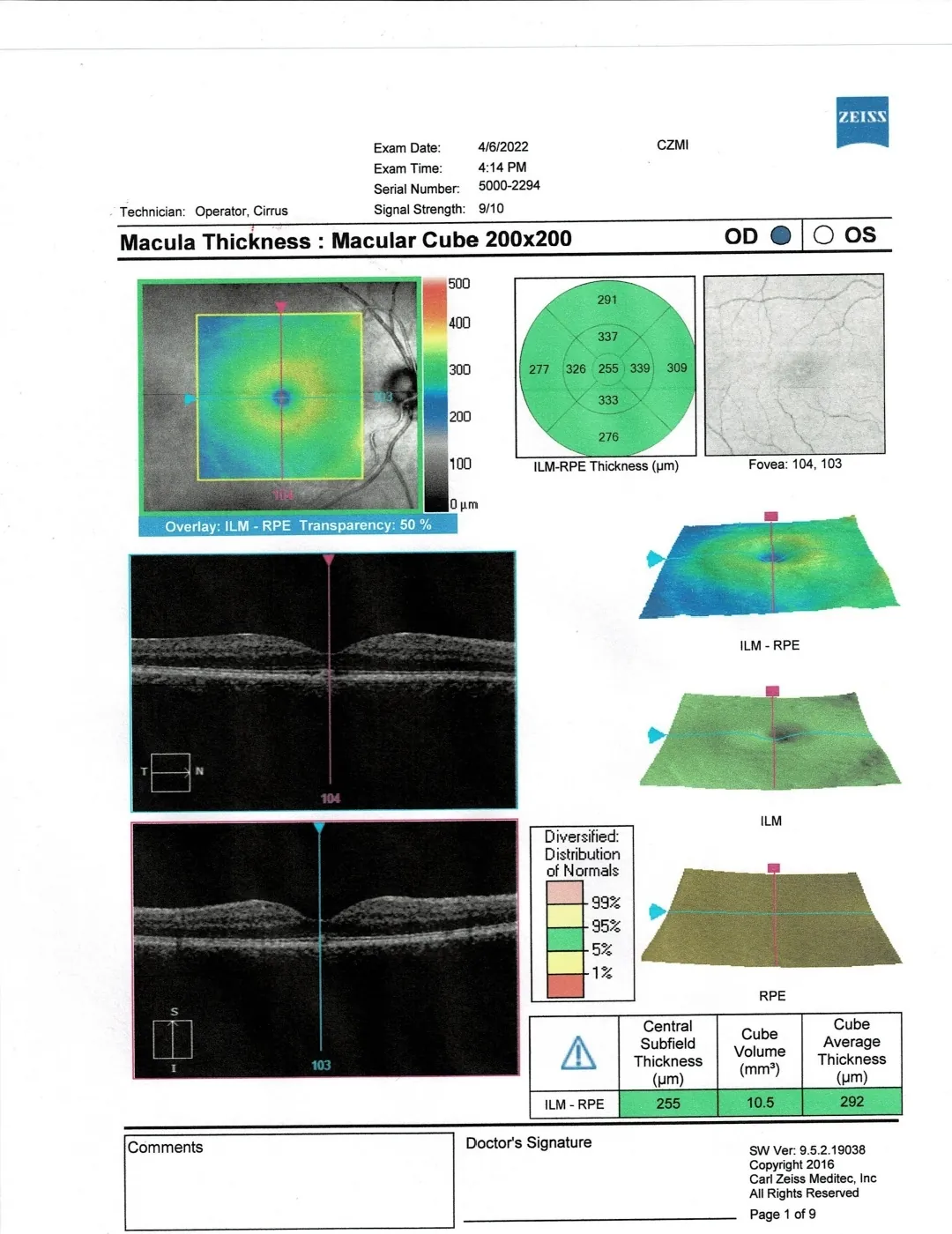
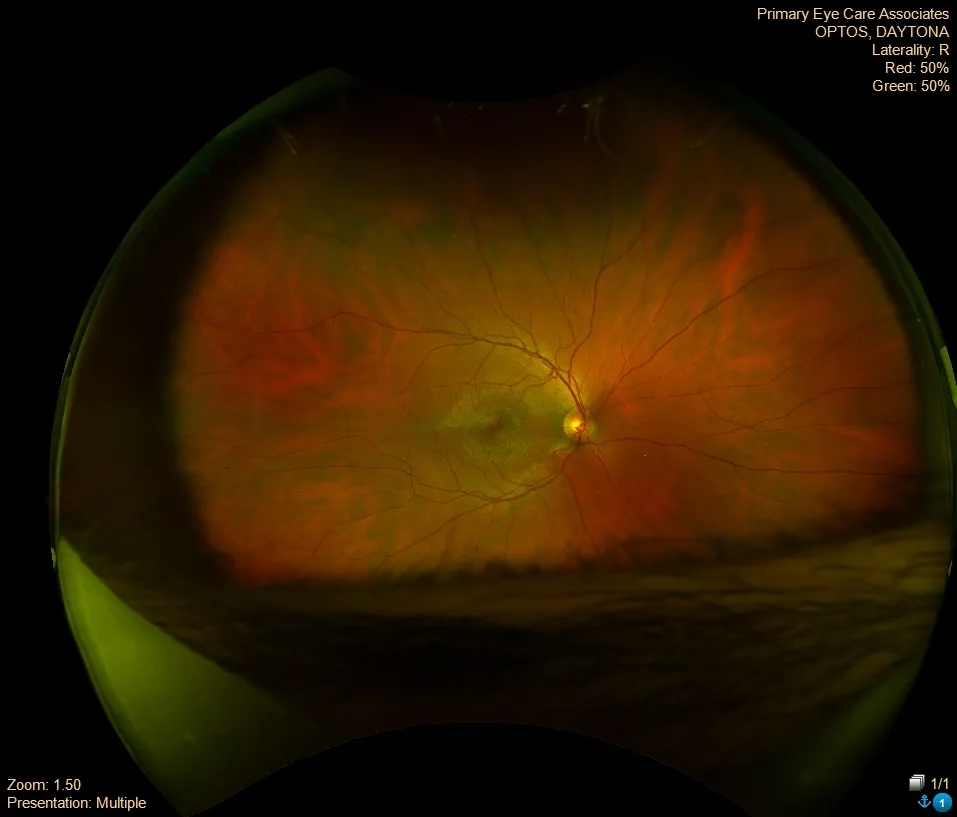
Clinical picture. Hours after exposure: blurred central vision, central or paracentral scotoma, metamorphopsia, after-images, headache, photophobia, sometimes dyschromatopsia. Optical coherence tomography shows disruption of outer retinal layers at the fovea; a yellow spot may be visible at the fundus.
Dose. Reviews and teaching sources (EyeWiki, RANZCO, Cleveland Clinic, Oman Journal of Ophthalmology 2024 review) associate injury with sungazing, eclipse viewing, welding arcs, lasers, and even brief unprotected glances under some optical conditions. Sadun and colleagues’ biophysical analysis (1984) argued that under ideal optical conditions injury can follow extremely short observation. Other clinical teaching notes that solar viewing through a small pupil may stay below a purely thermal burn threshold and still cross a photochemical threshold with sustained fixation on the order of a minute or more. RANZCO’s position statement states that a short duration of exposure, “as little as a few seconds of fixation on the sun,” can cause solar retinopathy. The exact minimum is not a single magic number: pupil size, refractive error (emmetropia focuses more tightly), age (clearer crystalline lens in the young), photosensitizing drugs, altitude, and whether the person is staring at a high-contrast disk against a dark eclipse sky all matter.
Who is at higher risk. Children and adolescents; people with clear lenses; post-cataract and post-laser patients; users of photosensitizing medications (tetracyclines, psoralens, and others); people with existing macular disease; psychiatric illness and intoxication (blink suppression, prolonged staring); anyone using binoculars or a telescope without a solar filter.
Course. Many patients improve over weeks to six months. Many do not return to a perfectly clean central field. Some are left with a permanent spot. There is no validated emergency antidote.
Religious and recreational clusters are documented: eclipse festivals, pilgrimage sungazing, mania, drone flying, and now algorithmic video.
The protocol’s own sentence is the correct one: Stop at the first hint of pain, squinting, headache, or lingering spots. That is an injury warning, not a milestone. Spots the next morning are not “pineal activation.”
Eclipse viewing is especially treacherous because the visible disk is dim while infrared and ultraviolet remain. Pupils dilate. The protocol’s ban on high-sun gazing is necessary but not sufficient during eclipses.
VIIThe 38-fold path: why dawn and dusk are optically different — and why “different” is not “safe”
The protocol’s atmospheric claim is physically real.
Air mass is the path length of sunlight through the atmosphere relative to the overhead path. By definition the zenith path is air mass 1. Because Earth is a sphere with a finite scale height (~8 km), air mass at the astronomical horizon is not infinite. Standard models (Kasten & Young 1989 and related geometric approximations) give a horizon air mass of about 38.
That longer path does three relevant things:
- 1. Scattering. Rayleigh scattering removes short wavelengths preferentially. The disk and the sky near the horizon go red and gold. Ultraviolet is also attenuated, which is why UV index at the surface is typically lower just after sunrise and before sunset than at noon—if the sun is actually near the horizon, not merely “morning” on a clock.
- 2. Absorption. Ozone, water vapor, and aerosols further shape the spectrum and reduce irradiance.
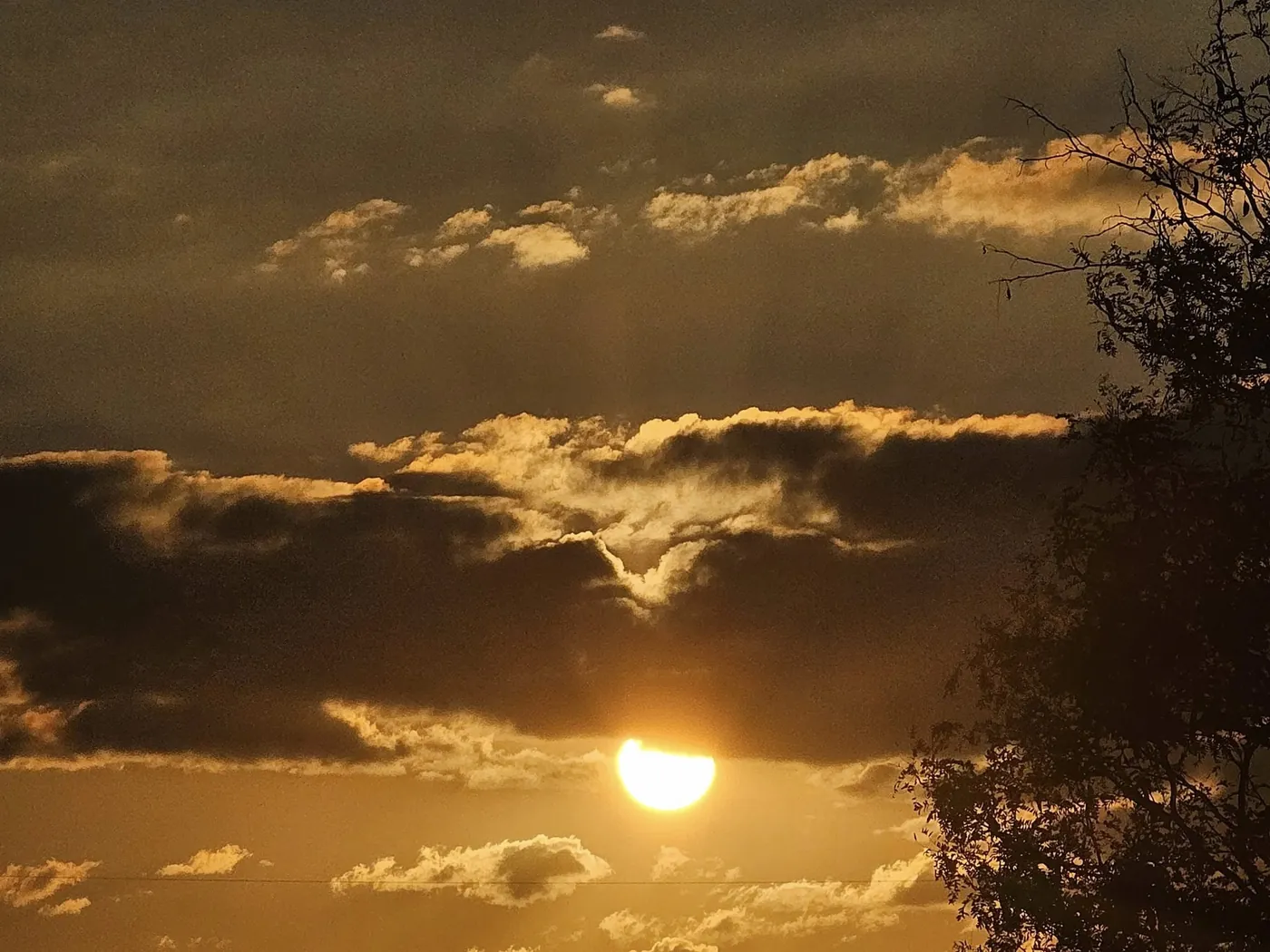
- 3. Irradiance drop. The solar disk at the horizon is far less radiant at the ground than the noon disk. That is why people can glance at a red sun without the same immediate dazzle.
Two caveats keep this from becoming a permission slip.
First, air mass collapses quickly as the sun climbs. Twenty minutes after sunrise at some latitudes the geometric advantage is already much smaller. A phone alarm labeled “sunrise + 45 minutes” is a legalistic window, not a spectrograph. Cloud, altitude, snow, and desert air change the optical path.
Second, redder is not harmless. Photochemical macular injury is driven in part by shorter visible wavelengths, but the fovea can still be injured by an intense, well-focused visible image. Infrared heating is reduced at the horizon but not abolished. The “safe window” is a harm-reduction heuristic used by traditional practitioners. It is not a finding that the fovea is designed for solar fixation.
There is a further, under-discussed irony. The circadian photoreceptor melanopsin is most sensitive in the blue-cyan band (~480 nm). Horizon sunlight is relatively depleted in that band. Dawn exposure still works because even a red-shifted sky is much brighter than a bedroom, and because rods and cones feed into the same ganglion cells. But if someone’s goal is maximum circadian signal per second, a bright blue-enriched sky a little later in the morning, without looking at the disk, is often a stronger clock stimulus than staring at a dim red sun. The spiritual aesthetic of the red disk and the engineering optimum for melanopsin are not the same target.
VIIIThe pineal gland: what it is, what it was, and what it is not
Phylogeny
In lampreys, many fishes, amphibians, and lizards, the pineal complex is a photoreceptive organ. Some species have a parietal “third eye.” Pinealocytes in those lineages are cousins of retinal photoreceptors: they detect light and they make melatonin. In mammals the pineal lost direct photosensitivity. It became a dedicated night-signal gland. The photic work moved into the eye.
That evolutionary move is the single most important scientific fact in this entire subject. Your pineal does not see the sunrise. Your retina does. The pineal hears about sunrise through a chain.
The mammalian chain
- 1. Intrinsically photosensitive retinal ganglion cells (ipRGCs) express melanopsin.
- 2. They project via the retinohypothalamic tract to the suprachiasmatic nucleus (SCN), the master clock.
- 3. The SCN, through the paraventricular nucleus, intermediolateral column, and superior cervical ganglion, controls the pineal.
- 4. In darkness, sympathetic norepinephrine drives pineal melatonin synthesis. In light, the chain inhibits that drive. Melatonin is the chemical syllable for “it is night, and this is how long the night is.”
Melatonin is not a mystic fluid. It is a timing hormone with receptor-mediated effects on sleep propensity, seasonal biology in photoperiodic animals, and a web of downstream physiology still being mapped. Light at night suppresses it. Morning light sets the phase so that melatonin can rise at a sane hour.
The pineal is also unusual among brain structures in sitting partly outside a tight blood–brain barrier and in receiving rich perfusion. That anatomy is relevant later, when calcification and fluoride accumulation enter the file. It does not make the gland a skylight.
Descartes and the later occult pineal
René Descartes (1640s) placed the rational soul at the pineal because the gland is unpaired, near the midline, and—he thought—well positioned to unite the two visual streams. He was wrong about the hydraulics and wrong about dualism’s anatomy, but he was reaching for a real problem: how a single field of experience arises from paired organs. Thomas Willis already objected that animals with little claim to a Cartesian soul have perfectly good pineal glands.
Nineteenth- and twentieth-century occultism (Blavatsky and after) re-read the pineal as ājñā, the third eye, a dormant organ of spiritual sight. Contemporary sungazing rhetoric often claims that photons “hit the pineal” or “decalcify” it. Anatomically the gland sits in the midline deep brain, behind the third ventricle, wrapped in meninges, not on an optical bench behind the pupil. Photons that enter the eye do not take a flashlight path through the skull into the pineal. They take a neural path.
The poetic third eye and the endocrine pineal should be allowed to remain cousins in metaphor. They should not be described as the same organ doing the same job.
A later section returns to calcification, endogenous tryptamines, and tests that are actually running. That material is placed there so it cannot be mistaken for the established anatomy just given.
IXLight as code
A photon is energy. It is also a symbol.
Claude Shannon’s 1948 paper, “A Mathematical Theory of Communication” (Bell System Technical Journal 27: 379–423, 623–656), defined information as reduction of uncertainty across a noisy channel: a sender, a codebook, a channel, a receiver. Weaver’s commentary in the 1949 book with Shannon made the triad of technical, semantic, and effectiveness problems explicit. Optical physicists then asked how many bits a photon can carry. James P. Gordon’s work on the quantum limits of optical communication, and later analyses by Giovannetti, Guha, Lloyd, Maccone, Shapiro, and colleagues, showed that a single photon can carry more than one bit if the alphabet includes arrival time, energy (wavelength), and polarization (see Giovannetti et al., Nature Photonics 8, 2014, for a review of classical capacity of bosonic channels). Laboratory free-space links have demonstrated on the order of ten to fifteen bits per received photon in photon-starved channels (Hippke, arXiv:1712.05682, compiling the photon-efficiency literature). The point for this essay is not the interstellar numbers. It is the grammar: light is already a coding medium. Biology got there first.
The retina is a photon counter before it is a camera. Hecht, Shlaer, and Pirenne (Journal of General Physiology 25, 1942) showed that a dark-adapted human rod can signal the absorption of a handful of photons; later work (Baylor, Lamb, and Yau; Field, Sampath, and Rieke, Annual Review of Physiology 2005) established that a single isomerized rhodopsin molecule is a reliable event. The codebook at that floor is binary in the crudest sense—present or not—but already timed: when the photon arrived matters to the spike. Color vision then adds a spectral alphabet. Three cone opsins (peaks near 420, 530, and 560 nm in a typical human) make a three-channel code whose opponency was described psychophysically by Hurvich and Jameson and given a retinal circuit by Dacey and others. The same photopic lux of a warm LED and of daylight can differ by a factor of two in melanopic weighted irradiance. The codebook cares about color even when the person is not “seeing color.”
A separate codec was identified at the turn of the millennium. Provencio and colleagues cloned melanopsin (1998, 2000). Berson, Dunn, and Takao (Science 295, 2002) showed that a class of retinal ganglion cells is intrinsically photosensitive. Hattar, Liao, Takao, Berson, and Yau (Science 295, 2002) traced those cells to the suprachiasmatic nucleus. The photopigment peaks near 480 nm. This is not image vision. It is a dedicated irradiance channel: how much light, of what band, for how long, at what clock hour. Doan, Fogelson, and colleagues, and later reviews by Lucas, Peirson, Brown, and the CIE, turned that channel into a unit. CIE S 026:2018 defines melanopic equivalent daylight illuminance so that lighting engineers and physiologists can speak the same code. Brown, Phillips, and colleagues (PLOS Biology 2022) then recommended about 250 lx melanopic EDI by day at the eye, about 10 lx in the evening, about 1 lx at night. That is a published codebook. It is the opposite of an unspecified stare at a star.
Timing is the dimension that makes identical photons opposite messages. Khalsa, Jewett, Cajochen, and Czeisler (Journal of Physiology 535, 2001) mapped the human phase-response curve to bright light: a pulse in the early biological morning advances the clock; a pulse in the late evening delays it. The same photons, opposite code, because the receiver’s state changed. Zeitzer, Dijk, Kronauer, Brown, and Czeisler (Journal of Physiology 526, 2000) showed that melatonin suppression in humans is already substantial at illuminances far below a sunny noon—and that the dose-response is saturating, not linear forever. A dawn outdoor stand and a phone at 1 a.m. are not “more light” and “less light” in a moral sense. They are different packets on the same clock channel.
Place of origin in the visual field is now a fifth, anatomical line in the codebook. A 2023 Nature Communications paper on a GlyT2-defined ipRGC subtype described a dorsal-retinal tile that selectively samples ground-directed luminance and projects to the supraoptic nucleus as well as the SCN. Upper-field sky light and lower-field ground light are not the same sentence. Duration is a sixth. ipRGCs integrate over seconds to minutes (Wong, Dunn, and Berson; later type-specific work on M1–M6). They are slow encoders. That slowness is a feature: clocks should not twitch with every passing cloud. It is also why a brief glance at a horizon and a nine-minute outdoor stand are different messages, and why a timed foveal fixation is a write into a different codec altogether.
Information theory also names the failure mode. Shannon’s channel has a capacity. Drive it past that capacity and the symbols do not become more meaningful; they become noise, then damage. Photochemical solar retinopathy (Sadun, Sadun, and Sadun, Archives of Ophthalmology 1984; Jourieh, Oman Journal of Ophthalmology 2024) is what happens when the foveal image channel is driven past capacity: reactive oxygen, outer-segment disruption, a scotoma. In information terms that is packet loss with scar. The legitimate medical uses of light respect capacity. Bright-light boxes specify lux and duration and tell the patient not to stare into the source (Terman and Terman; Wirz-Justice; Pail et al. reviews of light therapy). Photobiomodulation specifies nanometers and joules per square centimeter. Optogenetic therapies insert a new reader protein so that surviving cells can decode a chosen band (Sahel, Roska, and the GS030 work; Nanoscope MCO-010). None of these is “more sun.” They are specified senders.
Four dimensions of the solar codebook
The retinal and circadian systems do not read “the sun” as a blob of warmth. They parse at least four dimensions.
Intensity. How many photons per unit time, integrated over a large retinal field. This is the oldest non-image message: is it day.
Spectrum. Which wavelengths. Melanopsin peaks near 480 nm. S, M, and L cones and rods have their own peaks. The same photopic lux of warm LED and of daylight can differ by a factor of two in melanopic EDI. The codebook cares about color even when the person is not “seeing color.”
Timing. When the photons arrive relative to the organism’s internal day. A bright pulse at 8 a.m. phase-advances a typical human clock. The same pulse at 10 p.m. phase-delays it and suppresses melatonin. Identical photons, opposite code, because the receiver’s state changed.
Place of origin in the field. Some ipRGC populations are enriched in particular retinal regions. A 2023 study of a GlyT2-defined ipRGC subtype found a dorsal-retinal tile that selectively samples ground-directed luminance and projects to the supraoptic nucleus as well as the SCN. Non-image vision is not a single photometer. It is a small set of spatial channels. Upper-field sky light and lower-field ground light are not the same sentence.
A fifth dimension is duration and history. ipRGCs integrate over seconds to minutes. They are slow encoders. That slowness is a feature: clocks should not twitch with every passing cloud. It is also why a brief glance at a horizon and a nine-minute outdoor stand are different messages.
Parallel channels, not one wire
Mouse work now distinguishes at least six morphological ipRGC types (M1–M6), and clustering on function has suggested even more. M1 cells, especially the Brn3b-negative subset, carry most of the SCN innervation and therefore most of the clock-setting signal. Other M1 cells drive the pupillary light reflex through the olivary pretectal nucleus. M2 cells innervate both image-forming and non-image-forming targets. M4 cells, closer to alpha ganglion cells, contribute contrast-sensitive signals toward thalamus and have been implicated in mood-related circuits. Phototransduction itself diverges: M1 cells lean on TRPC channels; M2 cells recruit T-type voltage-gated calcium channels as well; M4 cells close leak potassium channels.
Translation out of the mouse: the eye is running several codecs at once. Image vision is one. Pupil is another. Clock is another. Mood and sleep-gating are others. Staring at the solar disk is a high-amplitude write into the image codec, which is the codec least designed for irradiance integration and most designed for spatial resolution. It is the wrong port.
That is why people with no image vision can still have a working body clock if melanopsin cells survive, and why people with intact image vision can have a broken clock if they live under dim indoor spectra at the wrong hours. A sunrise is a timestamp. A phone at 1 a.m. is a forged timestamp.
Channel capacity and injury
Every code has a damage threshold. Photochemical retinopathy is what happens when the foveal channel is driven past capacity. The symbols do not become “more meaningful.” The receiver’s hardware is rewritten by reactive oxygen and outer-segment disruption. In information terms that is not enlightenment. It is packet loss with scar.
The legitimate medical uses of light respect capacity. Bright-light boxes specify lux and duration and tell the patient not to stare into the source. Photobiomodulation specifies nanometers and joules per square centimeter. Optogenetic therapies insert a new reader protein so that surviving cells can decode a chosen band. None of these is “more sun.”
Reading versus writing
Natural vision reads an existing optical field. Several contemporary technologies write into neural tissue with light.
- • Photobiomodulation writes a mitochondrial message in red and near-infrared.
- • Optogenetics writes spikes by opening light-gated channels that the genome did not originally put there.
- • PRIMA writes an infrared image onto a subretinal photovoltaic chip, which then writes electrically into remaining inner retina.
- • Cortical visual prostheses, including the investigational Neuralink Blindsight concept, skip optics and write phosphenes into visual cortex.
Once light is understood as code, these devices are not science-fiction cousins of sungazing. They are the opposite strategy: replace an unsafe broadband sender with a specified one.
The religious intuition, restated without physics abuse
The Gāyatrī asks that solar radiance impel the intellect. John calls the Logos the light of all people. The Qur’an calls God the light of the heavens and the earth and then forbids prostration to the created sun. Plato puts the Good in the place of the sun outside the cave. These texts already treat light as a message about what is real. The neuroscience of melanopsin is the first time that intuition has a cell type, a photopigment, a tract, and a unit of measure. That is enough wonder. It does not require the fovea to double as an antenna pointed at a star.
XLight through the eye for health — the legitimate research program
Separate the following, which are real, from sungazing, which is not their method.
Bright-light therapy for seasonal affective disorder and circadian phase disorders uses controlled lux, usually from a lamp, usually in the morning, with instructions not to stare into the source. The target is ipRGCs and the SCN.
Architectural and public-health lighting tries to deliver high melanopic EDI by day and low melanopic EDI by night. This is the opposite of staring at a star. It is environmental design. The 250 / 10 / 1 lx melanopic EDI consensus is the first time the field has spoken in shared units.
Photobiomodulation (PBM) uses narrow bands of red and near-infrared light (commonly ~590, 660, 670, 850 nm) at low irradiance to modulate mitochondrial cytochrome c oxidase and downstream signaling. Ophthalmology has taken this seriously for dry age-related macular degeneration and other retinal conditions. The LIGHTSITE trials and the Valeda multiwavelength device produced enough controlled data for FDA authorization of a device-based treatment for dry AMD (2024). Laboratory work suggests 670 nm light can support aging mitochondrial function in the retina. This is dosed, filtered, non-solar-disk light. It is closer to a pharmacologic wavelength than to looking at the sun.
Repeated low-level red-light protocols for childhood myopia are a separate, still-debated clinical stream and are not sungazing.
The conceptual temptation is obvious: if red light can help a retina, the red morning sun must be the original device. The engineering reply is equally obvious: PBM specifies joules per square centimeter, duty cycle, and band. The sun specifies none of those at the fovea. Using a nuclear reactor to warm tea is not the same as using a kettle.
XINeuralink, optogenetics, and writing light into the brain
The honest connection is philosophical and technical, not clinical advice.
Cortical write: Blindsight and its predecessors
Blindsight, Neuralink’s investigational visual prosthesis, is designed to bypass the eye. Electrodes in visual cortex would generate phosphenes—artificial pixels—so that a person without functioning eyes or optic nerves might perceive a low-resolution field. FDA Breakthrough Device designation arrived in 2024. Published human efficacy data remain pending. Public remarks have described early vision as low-resolution, with speculative later expansion into infrared or other bands. Independent engineering commentary has been blunt that early cortical maps will not feel like natural sight. That is not a dismissal of the attempt. It is a resolution budget.
Earlier cortical efforts (Second Sight’s Orion, the Intracortical Visual Prosthesis Project) already showed that phosphene fields can be produced. The unsolved problem is turning a sparse constellation of dots into a usable world.
Retinal write: PRIMA
PRIMA (Science Corporation, originating in work by Daniel Palanker and Pixium) takes the opposite architectural choice: a roughly 2 mm subretinal photovoltaic chip that converts near-infrared patterns from glasses into electrical stimulation of remaining inner retina. Trial reports in geographic atrophy have described letter-reading restoration in a substantial fraction of implanted patients, with mean letter gains of several lines and commercial availability announced in Europe. Here light is again code—but the light is specified, infrared, and aimed at a chip, not at photoreceptors as a solar disk.
Cellular write: optogenetics in the living human retina
This is the most literal “light as code” medicine now in patients.
MCO-010 (sonpiretigene isteparvovec; Nanoscope Therapeutics) delivers a multi-characteristic opsin to bipolar cells by a single intravitreal injection. It is mutation-agnostic: it does not repair the broken photoreceptor gene; it gives surviving inner retina a new photopigment. The phase 2b/3 RESTORE trial in advanced retinitis pigmentosa reported statistically significant acuity gains versus sham on the order of three ETDRS lines at one year. The REMAIN follow-up, presented through 2025–2026 meetings including ARVO and ASRS, reported that those gains were still present at about three years (week 152), without treatment-related serious adverse events in the reported analyses. A rolling biologics license application has been discussed. These are still specialized, late-disease data. They are not a consumer product. They are also not a rumor.
Other optogenetic programs (including Restore Vision’s RV-001 chimeric rhodopsin approach, designed to work in ambient light without goggles) are in early human dosing. Parallel cell-replacement work (BlueRock / Bayer OpCT-001 iPSC photoreceptor trial CLARICO) attempts to put readers back rather than to reprogram the remaining ones.
The pattern across these technologies:
- • they treat light as a write signal;
- • they refuse uncontrolled broadband irradiance;
- • they assume the natural eye can fail and that the brain’s visual grammar can be addressed another way.
A speculative but clean research question follows. If dawn light is valuable because it is a timestamp for the SCN, a future interface could deliver that timestamp electrically or with safe indoor spectra, without asking the fovea to double as a solar collector. That would be the high-tech version of what a well-designed light box already approximates. It would not be “sungazing with a chip.” It would be chronobiologic writing.
The ethical shadow is equally clear. A culture that already injures teenagers with a hashtag should not be handed a story that “Neuralink will make staring at the sun obsolete and therefore the old practice was fine.” Prostheses exist because tissue breaks.
XIIGround contact: a second channel, a thinner file
The protocol treats barefoot contact as a separate environmental signal. That separation is conceptually right even if the evidence is uneven.
The Earth maintains a surface potential. A body isolated by rubber and plastic floors can sit at a different potential from local ground and can couple capacitively to building wiring. Conductive contact equalizes that potential. So much is ordinary electrostatics.
The health claims—normalized cortisol curves, reduced blood viscosity, faster recovery, less inflammation—rest on a small literature (Chevalier and colleagues and related pilots), often with tiny samples and overlapping authors, some commercially adjacent to grounding products. Independent reviewers at Science-Based Medicine judge the clinical file unimpressive. More sympathetic summaries call it preliminary and mechanistically interesting.
For this essay’s purposes: walking outside at dawn on wet grass is a low-cost, low-harm ancestral pattern. Do not let a grounding-sheet catalog become the load-bearing beam of a worldview. Do not let skepticism about mats become a reason to stay indoors under white LEDs until noon.
XIIIScripture and the eye of light
What follows is comparative, not confessional. Verses are cited as historical sources about how communities spoke of light and seeing. None of them is an instruction to fixate the solar disk.
Vedic and Hindu
- • Rigveda 3.62.10 (Gāyatrī): meditation on the excellent radiance of Savitṛ; may that light impel our insight.
- • Rigveda solar hymns: Sūrya as the all-seeing eye; dispeller of darkness and, in later commentarial tradition, of disease and bad dreams.
- • Sūrya Upaniṣad: the sun as the self of the moving and unmoving; “divine Savitṛ is our eye.”
- • Ādityahṛdayam (Rāmāyaṇa, Yuddha Kāṇḍa): the sun as witness of the worlds, as time, as the gods concentrated; a battlefield hymn, not a clinic.
- • Bṛhadāraṇyaka Upaniṣad 1.4.10 and the Vāmadeva verse: identification of the seer with the sun (“I was Manu and the sun”).
- • Bhagavad Gītā 4.1–2: yoga handed down through the sun.
- • Bhagavad Gītā 11: the cosmic form with sun and moon as eyes.
- • Īśa Upaniṣad 15: “The face of truth is covered with a golden disk; remove it, O Pūṣan, that I who love truth may see.” The disk here is a veil over truth, not a target for the retina.
- • Chāndogya Upaniṣad: the sun associated with the heavenly utterance svar; om as the essence drawn from the worlds.
Hebrew Bible and New Testament
- • Genesis 1:14–19: lights in the dome of the sky for signs, seasons, days, and years. The sun is a clock, not a god.
- • Deuteronomy 4:19; 17:2–5: Israel is not to be drawn into worship of sun, moon, and host of heaven.
- • Job 31:26–28: Job swears that if he looked at the sun when it shone, or the moon moving in splendor, and his heart was secretly enticed, that would be iniquity to be punished—the classic moralization of the solar gaze.
- • Ezekiel 8:16: twenty-five men in the Temple court, backs to the sanctuary, faces east, bowing to the sun. The prophet’s horror is liturgical: they have reversed the house.
- • 2 Kings 23:5, 11: Josiah destroys solar cult apparatus, including horses dedicated to the sun.
- • Psalm 19: the heavens declare; the sun comes out like a bridegroom. Nature speech, not ocular practice.
- • Psalm 84:11: “the Lord God is a sun and shield.”
- • Isaiah 60:19–20; Revelation 21:23: in the restored city, the sun is outshone by divine glory. Eschatology demotes the disk.
- • John 1:4–9; 8:12: the Logos as light of all people; “I am the light of the world.” Light is person and revelation.
- • Matthew 6:22–23: “The eye is the lamp of the body.” Moral epistemology of attention.
- • Acts 26:13: Paul struck by a light “brighter than the sun.” Uncreated light, not a method.
Qur’an
- • 41:37 (Fuṣṣilat): night and day, sun and moon are signs; “do not prostrate to the sun or to the moon, but prostrate to God who created them.”
- • 91:1–6 (al-Shams): oath by the sun and its morning brightness, by the moon when she follows, by the day when it displays the sun, by the night when it covers it.
- • 18:17 (al-Kahf): the cave sleepers and the sun’s path, a narrative of shelter from glare as much as of miracle.
- • 24:35 (al-Nūr): God as the light of the heavens and the earth; the famous niche-and-lamp parable. Light is theophany.
- • 24:30: believing men are told to lower their gaze—discipline of the eye as ethics, not astronomy.
Other streams
- • Egyptian hymns to Ra and Aten: the disk as nourisher; rays on the face; the two eyes of the sky.
- • Greek: Plato’s Republic 514a–520a, the Cave—the sun outside the cave is the Form of the Good. The philosophical life is a training in looking at what is brighter, but the metaphor is noetic, and Socrates warns that eyes hurt when they first meet daylight. Helios in Homer sees and hears all.
- • Buddhist: the Buddha as tathāgata compared to the sun; āloka (light) as a quality of knowledge in meditation manuals; Kasina practice includes a disk meditation that later traditions sometimes take as a solar disk, more often as a constructed circle. Caution about “sign” and glare is part of the commentarial tradition.
- • Daoist and Chinese: the sun as yang; imperial solar ritual at the Altar of the Sun; inner-alchemy language of solar and lunar essences circulating in the body. Again, metaphor-rich, method-poor for foveal staring.
- • Mishnah and later Jewish law: blessing the sun (birkat ha-ḥammah) once every twenty-eight years when the sun returns to a traditional starting point. The rite is calendrical gratitude, performed with a blessing, not a stare.
Across this library a pattern holds. Light is revelation, judgment, creation, and intellect. The eye is responsibility. When the solar disk itself becomes an object of worship, several of the Abrahamic texts move to forbid it. When the disk becomes a metaphor for truth, almost every tradition leans in. That distinction is the difference between a hymn and a burn.
XIVFurther angles that usually get omitted
- 1. The lost parietal eye. Evolution already ran the experiment of a photoreceptive pineal. Mammals closed that aperture and opened a more sophisticated one in the lateral eyes. Nostalgia for a “third eye that looks at the sun” is, in phylogenetic terms, a wish to revert to a lizard solution.
- 2. The fovea is the worst possible target. Circadian and pupillary functions are served by sparse ganglion cells across the retina, especially in the periphery. High-acuity cones packed at the fovea are the tissue solar retinopathy destroys. A practice that aims “activation” at the exact patch least involved in clock-setting and most involved in reading is poorly aimed even on its own theory.
- 3. Blink suppression is the hidden variable. Ordinary glances at a bright horizon include blinks, tears, aversion, and image motion. Injury reports often involve willful stillness—religious trance, a dare, a manic vigil, a camera. The protocol’s instruction to stop at squinting is an attempt to reinstall the aversion reflex that zeal removes.
- 4. Eclipse logic leaks into ordinary mornings. People learn, incorrectly, that the only dangerous sun is the eclipsed sun. The opposite is closer to truth: any time the disk is sharp enough to form a tiny, intense retinal image, the macula is at risk.
- 5. Photosensitization as a theological problem. Tetracyclines, some psychiatric drugs, St. John’s wort, and other agents lower the injury threshold. A “universal ancestral practice” that becomes dangerous the moment a person takes doxycycline was never a universal physiological constant.
- 6. Children. Pediatric lenses transmit more short-wavelength light. The protocol’s age cutoff is one of its most defensible lines.
- 7. The two modern deficits are real. Humans now live under weak indoor photic timestamps by day and strong artificial timestamps by night, and they live electrically insulated from soil. Those are fair diagnoses. The fair treatments are morning outdoor light not aimed at the fovea, dim evenings, and actual time on actual ground. Overshooting into disk fixation treats a lighting-design problem with a tissue-destructive tool.
- 8. Attention is the unmeasured outcome. Even if every photon claim failed, a daily unmediated encounter with the horizon would still be a training of attention in a culture that sells interruption. The scholarly task is to keep that psychological good from being used as cover for macular holes.
XVWorking hypotheses, live measurements, and tests already in motion
This section is where the essay allows itself to lean forward. It does not invent results. It names claims that are in circulation, says what the measurements actually show, and says what a serious test would have to look like. Readers who treat every hypothesis as a finding will misread it. Readers who treat every hypothesis as a joke will miss the part of the subject that is still moving.
1. Pineal calcification is real. “Decalcification” is not a demonstrated therapy.
Corpora arenacea—brain sand—are hydroxyapatite concretions inside the pineal. A 2023 systematic review and meta-analysis put pooled imaging prevalence around 62 percent across ages, higher in older adults and in some series in males. Calcification can begin earlier than folklore admits; it is a common incidental CT finding.
What tracks function is not “calcified / not calcified” as a binary. Several studies find that uncalcified pineal volume correlates better with urinary melatonin metabolites than a crude calcification score does. Sleep findings are mixed: some work links higher calcification to worse sleep efficiency and less REM; a 2025 analysis of about a thousand people found no association between pineal calcification volume and Pittsburgh Sleep Quality Index after demographic adjustment, and suggested remaining tissue may compensate. A 2025 cadaver series (Nooma and colleagues, Kurume Medical Journal) reported a negative correlation between brain-sand burden and melatonin-antibody-positive pineal cells, plus associations with lower calcaneal bone density and more aortic atherosclerosis—hypothesis-generating, n = 20, not a clinic protocol.
A 2025 comparative transcriptomic analysis argues that pineal mineralization is not mere rust but a regulated program that reuses Hedgehog, Notch, and chromatin pathways familiar from bone. If that holds, “decalcify with a juice” is the wrong theory of the lesion.
Fluoride. Jennifer Luke’s 2001 cadaver work showed that aged human pineals can carry fluoride concentrations in calcified tissue comparable to bone, correlated with calcium. That is accumulation in an already mineralizing matrix. It is not proof that community-water fluoride causes the mineralization, and large fluoridation reviews have not produced a clean human melatonin signal at ordinary exposure. Avoiding fluoride toothpaste is a preference. It is not a replicated pineal therapy.
What has not been shown: any supplement, sungazing protocol, or “activation” practice reversing human pineal calcification on imaging and raising melatonin metabolites in a controlled trial. Popular lists (K2, boron, iodine, tamarind) have not been tested against that endpoint.
What a serious test would look like. Pre-registered protocol; quantitative CT or high-resolution MRI of uncalcified pineal volume; serial 6-sulfatoxymelatonin; actigraphy and dim-light melatonin onset; a specified light intervention that does not include solar-disk fixation; adequate n; independent lab. Until that exists, “I decalcified my pineal at sunrise” is a sentence about feeling, not about hydroxyapatite.
2. Endogenous DMT exists. The pineal-flood story does not currently carry the dose.
Rick Strassman’s clinical DMT work in the 1990s, later framed in DMT: The Spirit Molecule, proposed that the pineal might release psychoactive amounts of N,N-dimethyltryptamine at birth, death, and certain extreme states. That proposal organized a generation of popular pineal talk. The laboratory file that followed is more modest and more interesting than the slogan.
- • DMT and related tryptamines have been detected in human peripheral fluids at trace levels (Barker, McIlhenny, and Strassman review, 2012).
- • Barker, Borjigin, Lomnicka, and Strassman (2013) detected DMT in living-rat pineal microdialysate.
- • Dean, Borjigin, and colleagues (2019) found cortical extracellular DMT in rats at concentrations they compared to classic monoamines; pinealectomy did not abolish cortical DMT, which means the pineal is not the required factory. Cardiac arrest raised cortical DMT along with other transmitters.
- • Nichols (2018) argued the arithmetic: the adult pineal weighs under 0.2 g and makes on the order of 30 micrograms of melatonin a day; an intravenous psychedelic DMT dose is tens of milligrams, arriving fast, against monoamine oxidase. The gland cannot be a hidden DMT geyser on those numbers.
- • Subsequent reviews through 2026 split the field into a strong experiential view, a strong skeptical view, and a “subtle physiology” view in which trace DMT might matter at sigma-1 or other intracellular sites without being a trip. Almost all of the brain data is rat. Human brain evidence is thin.
Accurate sentence: your body can make DMT; your pineal is not a proven psychedelic organ; sungazing has no demonstrated relationship to either fact.
The reason to keep the file open is not romance. It is that tryptamine metabolism, INMT expression (higher in lung, thyroid, and adrenal than in pineal), and extreme-state neurochemistry are live experimental subjects. Anyone who uses them as a sungazing sales pitch is skipping the part labeled “unknown.”
3. Light is already being used as a write instruction in human eyes.
Section XI summarized the trials. The hypothesis this section adds is narrower: if inner retinal cells can be given a new opsin and can then decode ambient photons into useful acuity for years, then the remaining retina is a programmable reader. That does not imply that pointing the old reader at the solar disk is programming. It implies the opposite: programming is specific.
A second live write-path is PBM in dry AMD. Whatever one thinks of effect sizes, the field has moved from anecdote to sham-controlled, multi-wavelength, regulator-facing data. The next five years of extension studies will matter more than slogans.
4. Hypotheses that are testable without asking anyone to stare at the sun
These are offered as designs, not as results.
- • Timestamp dose-response. Compare three morning conditions in the same subjects: indoor dim; outdoor dawn without disk fixation for a fixed melanopic-EDI-minute dose; the same outdoor time facing away from the disk. Endpoints: dim-light melatonin onset, next-night sleep efficiency, next-day alertness, mood scales. Prediction from current physiology: outdoor wins; disk fixation adds risk without adding clock signal.
- • Uncalcified volume under a lighting intervention. The calcification trial sketched above, using only safe outdoor light and evening light hygiene.
- • ipRGC-weighted architecture. Buildings and bedrooms that hit 250 / 10 / 1 lx melanopic EDI, measured vertically at the eye, against ordinary lighting, with sleep and metabolic endpoints. This work is already underway in lighting science; it does not need a solar disk.
- • Prosthetic timestamps. In future cortical or optic-nerve interfaces, a low-bandwidth “day/night” channel written to hypothalamus or to surviving ipRGC axons, independent of image vision. That would be the first time a human clock could be set without using the eyes at all. It is not available. It is the logical child of the anatomy in Section VIII.
5. What “promising” is allowed to mean here
Promising, in this essay, means: a mechanism that has survived contact with measurement, a trial that has a protocol and a control, or a correlation that specifies its own next experiment. It does not mean a podcast claim about third-eye juice. The pineal is interesting enough as a melatonin gland with an aging mineral problem. Light is interesting enough as a four-dimensional code that clocks, pupils, and moods already parse. Adding a secret glandular movie onto that stack does not make it more scientific. It makes it louder.
XVISynthesis
Keep the protocol’s humility. Aurelia is a timer and almanac. It is not a sacrament and not a clinic.
What history actually gives: a planet of peoples who prayed facing the sun, timed their law courts and sowing to its path, and used light as the master metaphor for knowledge.
What physiology actually gives: a non-image-forming visual system that wants bright days and dark nights; a pineal that listens to that system; a fovea that can be photochemically burned; a mitochondrial literature on controlled red and near-infrared light that must not be smuggled in as proof of sungazing.
What religion actually gives: verses that call God or Brahman or the Good by the name of light, and other verses that forbid bowing to the created disk.
What engineering is beginning to give: prostheses that write visual information with infrared patterns or cortical electrodes, which is to say, light and electricity used as code.
The impressive fact is not that a person can stare at the sun. The impressive fact is that a thin sheet of neural tissue can turn an ancient nuclear reactor, eight light-minutes away, into the experience of morning—and that the same tissue, if asked to stare, can be quietly and permanently scarred. Reverence belongs to that conversion. Caution belongs to it too.
Selected sources
Ophthalmology and photic injury
- • Jourieh, M. “Solar retinopathy: A literature review.” Oman Journal of Ophthalmology 17, no. 2 (2024): 173–180. PMC11309525.
- • Chen, K. C., et al. / related case literature. “Solar retinopathy secondary to sungazing.” BMJ Case Reports (2013). PMC3604317.
- • Nix, R. R., et al. “Solar retinopathy from sungazing in Medjugorje.” Journal of the Louisiana State Medical Society 139, no. 8 (1987): 36–40.
- • Sadun, A. C., A. A. Sadun, and L. A. Sadun. “Solar retinopathy: A biophysical analysis.” Archives of Ophthalmology 102, no. 10 (1984): 1510–1512.
- • American Academy of Ophthalmology. “Solar Retinopathy.” EyeWiki.
- • Cleveland Clinic. “Solar Retinopathy: Symptoms, Causes & Recovery.”
- • Royal Australian and New Zealand College of Ophthalmologists. Position Statement: Solar Retinopathy (2023).
- • “A Review of Photic Retinopathy.” Retinal Physician (June 2020).
- • Clinical Insights in Eyecare. “Case Report: Solar Retinopathy Secondary to the Viral TikTok Trend ‘#SunGazing’” (2024).
- • Wikipedia. “Sungazing.” (Used only as a lead to primary clinical sources; the medical consensus statement is independently attested above.)
Circadian biology, pineal, melanopsin
- • Macchi, M. M., and J. N. Bruce. “Human pineal physiology and functional significance of melatonin.” Frontiers in Neuroendocrinology (2004).
- • “Physiology of the Pineal Gland and Melatonin.” Endotext. NCBI Bookshelf. NBK550972.
- • “Neuroanatomy, Nucleus Suprachiasmatic.” StatPearls. NCBI Bookshelf. NBK546664.
- • Stehle, J. H., et al. “A survey of molecular details in the human pineal gland…” Journal of Pineal Research (2011).
- • Korf, H.-W. “Photoneuroendocrine, circadian and seasonal systems…” Cell and Tissue Research (2024).
- • Berson, D. M., F. A. Dunn, and M. Takao. Foundational ipRGC papers (2002 onward); reviewed in later melanopsin surveys.
- • Klein, D. C., R. Y. Moore, and S. M. Reppert, eds. Suprachiasmatic Nucleus: The Mind’s Clock. Oxford University Press, 1991.
Photobiomodulation and ocular light therapy
- • Reviews of PBM in retinal disease: Frontiers in Ophthalmology (2024); International Journal of Molecular Sciences / related 2025–2026 syntheses of LIGHTSITE and Valeda data.
- • Siqueira, R. C., et al. “Photobiomodulation Using Light-Emitting Diode (LED) for Treatment of Retinal Diseases.” PMC10813238.
- • Shinhmar, H., et al. work on 670 nm light and aged retinal function (University College London group).
- • FDA public materials on the Valeda Light Delivery System authorization for dry AMD (2024).
Neural interfaces
- • IEEE Spectrum. “Neuralink’s Blindsight Device Is Likely to Disappoint” (2024), on expected resolution limits.
- • Waisberg, E., J. Ong, and A. G. Lee. “The potential to restore vision with Neuralink’s ‘Blindsight’…” Pan-American Journal of Ophthalmology (2024).
- • Wired / Science Corporation reporting on the PRIMA subretinal photovoltaic implant (2024–2026).
- • Ophthalmology Times Europe. “PRIMA… commercially available in Europe…” (2026).
- • Musk public remarks on Blindsight resolution and spectral expansion (2024–2025), treated as claims, not results.
History of solar religion and yoga
- • Rigveda 3.62.10 and solar hymns; standard critical editions and translations (Jamison & Brereton; older Griffith for public-domain wording).
- • Sūrya Upaniṣad; Ādityahṛdayam in Vālmīki Rāmāyaṇa, Yuddha Kāṇḍa.
- • Bhagavad Gītā 4.1–2; 11.
- • Assmann, Jan. The Search for God in Ancient Egypt. Cornell University Press, 2001; Egyptian Solar Religion in the New Kingdom. Routledge.
- • Quirke, Stephen. The Cult of Ra: Sun-Worship in Ancient Egypt. Thames & Hudson, 2001.
- • Hornung, Erik. Akhenaten and the Religion of Light. Cornell University Press, 1999.
- • Kemp, Barry. The City of Akhenaten and Nefertiti: Amarna and Its People. Thames & Hudson, 2012.
- • Nunn, John F. Ancient Egyptian Medicine. University of Oklahoma Press, 1996; Ghalioungui, Paul. The House of Life: Magic and Medical Science in Ancient Egypt.
- • Pinch, Geraldine. Egyptian Mythology. Oxford University Press, 2002; Ritner, Robert K. The Mechanics of Ancient Egyptian Magical Practice. Oriental Institute.
- • Belmonte, J. A., and M. Shaltout, eds. In Search of Cosmic Order: Selected Essays on Egyptian Archaeoastronomy. SCA, 2009.
- • Jacobsen, Thorkild. The Treasures of Darkness. Yale University Press, 1976; Bottéro, Jean. Religion in Ancient Mesopotamia. University of Chicago Press, 2001.
- • Lambert, W. G. Babylonian Wisdom Literature. Oxford, 1960 (Great Hymn to Shamash).
- • Rochberg, Francesca. The Heavenly Writing. Cambridge University Press, 2004; Horowitz, Wayne. Mesopotamian Cosmic Geography. Eisenbrauns.
- • Geller, Markham J. Ancient Babylonian Medicine. Wiley-Blackwell, 2010; Scurlock, JoAnn, and Burton R. Andersen. Diagnoses in Assyrian and Babylonian Medicine. University of Illinois Press, 2005.
- • Boyce, Mary. A History of Zoroastrianism, vol. 1. Brill; Zoroastrians: Their Religious Beliefs and Practices. Routledge.
- • Malandra, William W. An Introduction to Ancient Iranian Religion. University of Minnesota Press, 1983 (Mihr Yasht).
- • Clauss, Manfred. The Roman Cult of Mithras. Routledge, 2000; Beck, Roger. The Religion of the Mithras Cult in the Roman Empire. Oxford University Press, 2006.
- • Halsberghe, Gaston H. The Cult of Sol Invictus. Brill, 1972; Hijmans, Steven E. Sol: The Sun in the Art and Religions of Rome. 2009.
- • Aveni, Anthony F. Skywatchers. University of Texas Press, 2001; Empires of Time. Basic Books.
- • Milbrath, Susan. Star Gods of the Maya. University of Texas Press, 1999; Sahagún, Bernardino de. Florentine Codex, Book 7.
- • Urton, Gary. At the Crossroads of the Earth and Sky. University of Texas Press, 1981; Zuidema, R. T. work on the Cusco ceque system.
- • Hardacre, Helen. Shinto and the State, 1868–1988. Princeton University Press, 1989; Kojiki and Nihon Shoki, standard editions.
- • Burkert, Walter. Greek Religion. Harvard University Press, 1985; Plato, Republic VI–VII.
- • CIE S 026:2018; Brown, T. M., et al., “Recommendations for daytime, evening, and nighttime indoor light exposure…,” PLOS Biology (2022); CIE TN 015:2023.
- • Belay, D. G., and A. Worku. “Prevalence of pineal gland calcification.” BMC Neurology (2023).
- • Tan, D. X., et al. “Pineal calcification, melatonin production, aging…” Current Aging Science (2018).
- • Nooma, K., et al. Kurume Medical Journal (2025).
- • Luke, J. pineal fluoride cadaver study (2001); NRC fluoride review (2006).
- • Barker, S. A., J. Borjigin, et al. Rat pineal DMT microdialysis (2013).
- • Dean, J. G., et al. Cortical DMT in rat (2019).
- • Nichols, D. E. “N,N-dimethyltryptamine and the pineal gland: Separating fact from myth” (2018).
- • Shannon, C. E. “A Mathematical Theory of Communication.” Bell System Technical Journal 27 (1948): 379–423, 623–656; Shannon and Weaver, The Mathematical Theory of Communication (1949).
- • Giovannetti, V., S. Guha, S. Lloyd, L. Maccone, J. H. Shapiro, and H. P. Yuen. Reviews of the classical capacity of bosonic / photon channels; Nature Photonics 8 (2014); Hippke, M., photon information efficiency, arXiv:1712.05682.
- • Hecht, S., S. Shlaer, and M. H. Pirenne. “Energy, Quanta, and Vision.” Journal of General Physiology 25 (1942): 819–840; Field, G. D., A. P. Sampath, and F. Rieke. Annual Review of Physiology (2005).
- • Berson, D. M., F. A. Dunn, and M. Takao. Science 295 (2002); Hattar, S., et al. Science 295 (2002); Provencio, I., et al. melanopsin cloning papers (1998–2000).
- • Khalsa, S. B. S., et al. “A phase response curve to single bright light pulses in human subjects.” Journal of Physiology 535 (2001); Zeitzer, J. M., et al. Journal of Physiology 526 (2000).
- • Nanoscope MCO-010 RESTORE/REMAIN presentations, ASRS and ARVO (2025–2026).
- • Nature Communications (2023) on dorsal-retina ipRGCs to the supraoptic nucleus.
- • Haṭha Yoga Pradīpikā 2.31–32 on trāṭaka; Gheraṇḍa Saṃhitā.
- • Singleton, Mark. Yoga Body: The Origins of Modern Posture Practice. Oxford University Press, 2010.
- • Sarbacker, Stuart R. “Prostration or Potentiation? … the ‘Sun Salutation.’” Journal of Yoga Studies.
- • Russell, James Dylan. “Sūryanamaskār: Tracing the Origins of Yoga’s Sun Salutation.” Journal of Yoga Studies (2025).
- • Srivastava, V. C. Sun-Worship in Ancient India.
- • “The Saurasaṃhitā: The Earliest Surviving Tantra on Sun-Worship.” Acta Orientalia (2020).
- • Frawley, David. “The Ancient Yoga of the Sun.” American Institute of Vedic Studies (interpretive; use alongside critical historians).
- • Britannica. “Sun worship.”
- • Budge, E. A. Wallis. Hymns to the Sun-God in Tutankhamen: Amenism, Atenism and Egyptian Monotheism (1923).
- • Brown, Lawrence Parmly. “The Cosmic Eyes.” The Open Court (on sun and moon as divine eyes).
Modern sungazing movement
- • Bates, W. H. The Cure of Imperfect Sight by Treatment Without Glasses (1920), as historical source.
- • British Medical Journal 1 (1967): 570, discussion of the Bates method (“disastrous results”); Pollack, Philip. The Truth about Eye Exercises. Philadelphia: Chilton, 1956.
- • Elliott, D. B. “The Bates method, elitism and the suppression of innovation (not).” Ophthalmic and Physiological Optics (2013), and AAO/RANZCO statements on the Bates method.
- • Huxley, Aldous. The Art of Seeing. 1942 (popular Bates reception, not evidence).
- • Eat the Sun (dir. Peter Sorcher, 2011) and contemporaneous reporting.
- • The Hindu. “The man who consumed the sun is no more” (obituary of Hira Ratan Manek, 2022).
- • The Skeptic (UK). “Sungazing, or staring directly at the sun, is definitely not good for your health” (2025); “Eat the Sun: an ophthalmologist’s review” (2022).
- • Hope-Ross, M., S. Travers, and D. Mooney. Eclipse and sungazing retinopathy papers, British Journal of Ophthalmology (1990s cluster).
- • Wikipedia. “Inedia”; “Hira Ratan Manek” / Wikiquote (claims vs. documentation); contemporaneous reporting on breatharian deaths (Verity Linn, 1999, and related cases).
Atmosphere
- • Wikipedia. “Air mass (astronomy).”
- • Kasten, F., and A. T. Young. “Revised optical air mass tables and approximation formula.” Applied Optics 28 (1989): 4735–4738.
- • PVEducation. “Air Mass.”
- • Kaler, James B. The Ever-Changing Sky (airmass diagrams; horizon ~38).
Grounding
- • Chevalier, G., et al. papers in Journal of Environmental and Public Health (2012), Journal of Alternative and Complementary Medicine (2013), and the 2015 inflammation review.
- • Oschman, J., G. Chevalier, and R. Brown. “The effects of grounding…” various.
- • Gorski, D. / Science-Based Medicine. “Earthing Update” (2023), for the skeptical appraisal.
Descartes and pineal history
- • Descartes, René. Les Passions de l’âme (1649); L’Homme (1664); letters of 1640 on the conarium.
- • Lokhorst, G.-J. “Descartes and the Pineal Gland.” Stanford Encyclopedia of Philosophy.
- • Hektoen International. “The pineal: Seat of the soul.”
- • Willis, Thomas. Cerebri Anatome (1664), critique of the Cartesian pineal.
Scripture (editions)
- • Hebrew Bible / New Testament: NRSV or comparable critical translation.
- • Qur’an: Abdel Haleem or Arberry, sūrahs 18, 24, 41, 91.
- • Plato. Republic VII.
- • Standard Upaniṣad translations (Olivelle).
This essay is historical and scientific commentary. It does not modify the protocol’s medical disclaimers and does not recommend looking at the sun.