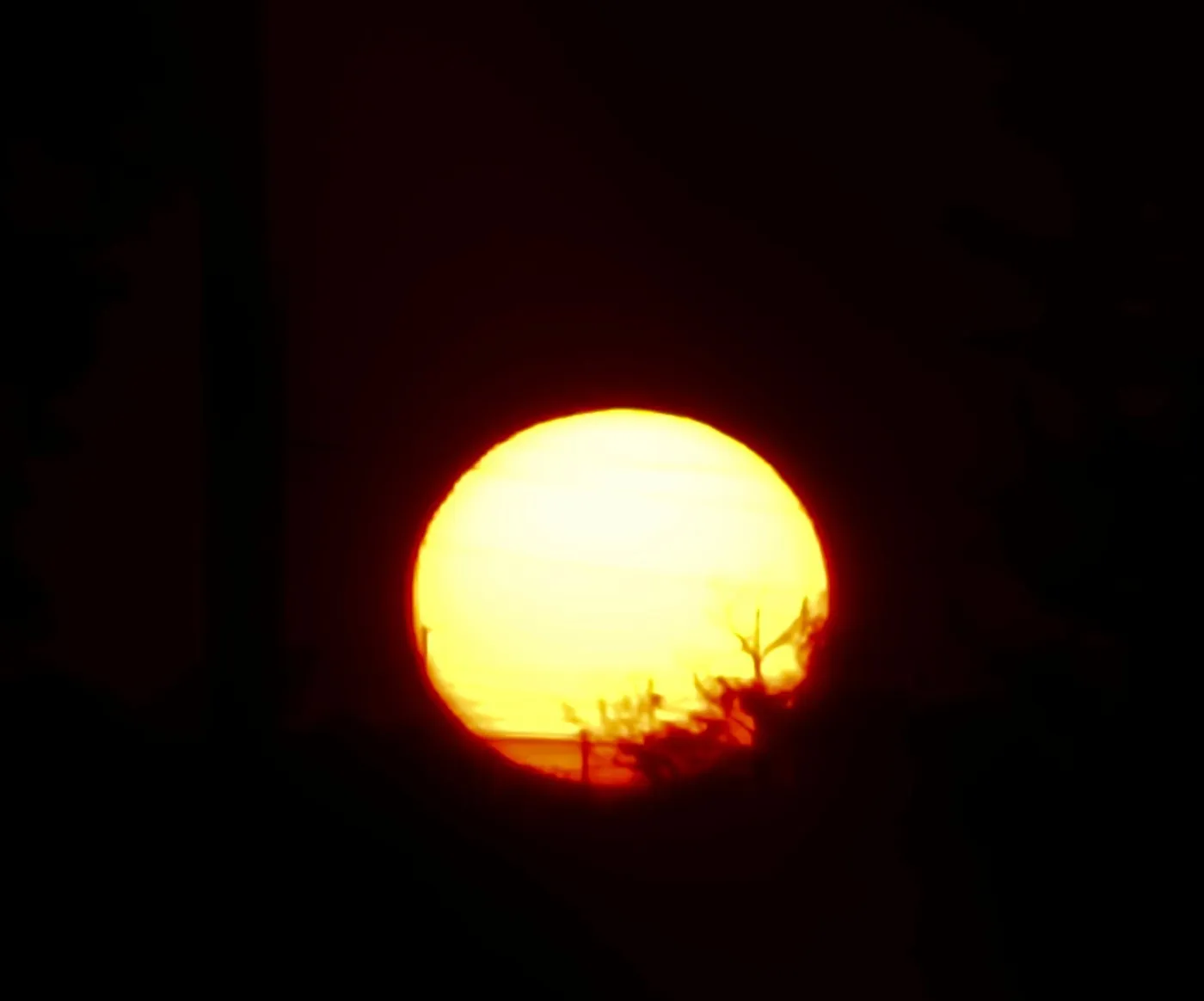
SpaceX’s public architecture for climbing the Kardashev ladder begins with a fact of geometry, not rhetoric. A photovoltaic array in continuous sunlight, above atmosphere and weather, intercepts roughly 5 times the annual energy of an identical panel on Earth’s surface. The stated stack is therefore simple: harvest that flux in orbit, fabricate the next generation of satellites from local mass, and convert a non-trivial fraction of the star’s output into usable power. The Moon is the near-term factory node rather than a detour. Lunar regolith supplies silicon and oxygen. A launch window opens about every 10 days, versus about 26 months for a Hohmann transfer to Mars. A mass driver can throw finished hardware off the surface without another chemical rocket. That is solar physics plus lunar resources plus Starship cadence, said in public.
The same star that would feed those arrays is still poorly understood at the scales that matter. Its photosphere radiates as a blackbody whose spectral energy density peaks in the teal, near 500 nm. It looks white from space, and yellow from the ground, only because the eye integrates the whole visible band and Rayleigh scattering removes the short-wavelength tail. Stanford solar physicists still open lectures with that curve because it dissolves the “yellow dwarf” cartoon in a single plot of Planck’s law.
The Corona That Should Not Be That Hot
What sits above that surface is stranger still. The photosphere is about 5500 °C. The corona that rests on it is 1–2 million °C. Heat is flowing the wrong way. NASA’s Parker Solar Probe first entered that plasma in 2021, set a closest-approach record of about 3.8 million miles on 24 December 2024, and matched that record again on 4 September 2026 on its 29th perihelion, sampling nearly 40 percent of the solar circumference in a single day at about 430000 miles per hour. The mission has been extended into 2029.
Parker’s FIELDS and SWEAP instruments found ubiquitous magnetic switchbacks: sudden reversals of the radial field that dump energy into the plasma. ESA/NASA Solar Orbiter, flying farther out and now climbing out of the ecliptic, tracked the same wind and showed Alfvén waves accelerating and heating the flow. In 2025–2026 analyses of heliospheric current-sheet crossings below 50 solar radii, about 82 percent of those crossings showed reconnection jets. At one Encounter 14 crossing near 16.25 solar radii, protons were energized to about 400 keV — roughly 1000 times the available magnetic energy per particle. Existing models of reconnection at that location had not predicted that reservoir.
What sits above that surface is stranger still.
The heating problem is no longer only a question of large flares. Solar Orbiter’s Extreme Ultraviolet Imager, operating as close as 0.29–0.56 AU, resolved “campfires” and then a still-smaller population now called picoflares. In closest-perihelion sequences, a wavelet search found events down to about 10000 km² and lifetimes as short as 3 seconds. Occurrence estimates reach about 3600 EUV brightenings per second over the whole Sun. Energy analyses of more than 12000 events place them between about 10²⁰ and 10²⁴ erg. They occur up to 60 times more often than nanoflares seen from 1 AU and supply on the order of 1 percent of quiet-Sun coronal heating — not the whole answer, but a measured rung on Parker’s original nanoflare ladder that Earth-orbit telescopes could not resolve.
The Interior Clock
The 11-year cycle is written in a shear layer, not a metaphor. Helioseismology maps the tachocline: a thin transition between the uniformly rotating radiative interior and the differentially rotating convective envelope. It remains the leading site for the dynamo that reverses the polar fields and sets the amplitude of the next cycle. Polar fields measured by SDO/HMI, not folklore, are the precursor.
Neutrinos leave the core in minutes. Photons do not. Electron neutrinos from the proton–proton chain reach Earth in about 8 minutes. Photons random-walk out of the radiative zone on the order of 10⁴–10⁵ years. Super-Kamiokande and SNO turned that contrast into a measurement.
Cycle 25 is not a sine wave. SIDC/SILSO in Brussels publishes the international sunspot number used by NASA and ESA. The 13-month smoothed maximum was reached in October 2024 at about 161. The cycle ranks as weak-to-moderate among the last 25 cycles, yet it has already produced more than 2000 M- and X-class flares — more than the entire previous cycle — and remains capable of severe storms well into the declining phase through 2026. Polar-field reversal completed in 2023. That, not a cartoon peak date, now constrains Cycle 26.
A Global Observatory, Not a Single Flag
The Sun is no longer a NASA-only instrument.
India’s Aditya-L1 has sat at L1 since 6 January 2024. SUIT opened the near- and mid-ultraviolet (2000–4000 Å) disc. HEL1OS monitors flares from 8–150 keV. ASPEX-STEPS has returned a year of directional energetic-ion spectra that correlate tightly with other L1 monitors and provided the first in-situ confirmation of a 40-year-old prediction that solar-wind suprathermal ions become isotropic in quiet flow. Photospheric iron fluorescence at 6.40 keV was measured across 47 X-class flares in 2024 when flare X-rays fluoresced neutral iron in the cooler photosphere.
China’s ASO-S (Kuafu-1), launched 8 October 2022, now has a Solar Physics topical collection of 30 papers plus more than 100 related publications. Full-disc vector magnetograms, unique Earth-perspective hard X-ray images, and routine Lyman-α disc-to-2.5-R☉ coronagraphy tie magnetic field, flare, and CME in one platform through Cycle 25 maximum.
Japan’s Hinode still delivers the vector magnetograms that anchor surface-field models.
Solar Orbiter continues its climb out of the ecliptic; first polar images are already in hand, and a dedicated Chinese Solar Polar-orbit Observatory is planned for 2029.
Why the Teal Peak Matters for Harvest
Wien’s displacement law puts the blackbody maximum at λ_max T ≈ 2.897 × 10⁻³ m·K. For T ≈ 5772 K, λ_max ≈ 502 nm — teal, not yellow. Space-based arrays therefore see a spectrum that terrestrial panels never do: no air-mass 1.5 cutoff, no night, no weather. Combined with lunar silicon and a 10-day launch cadence, that spectrum is the physical reason the orbital-harvest stack is not science fiction. It is radiative transfer plus resource geography plus flight rate.
The corona’s million-degree plasma, the picoflare rain, the tachocline dynamo, and the 8-minute neutrino clock are the same star. The factory proposal and the physics lectures are one object.
Sources
- Narang, N., et al. (2025). Extreme-ultraviolet transient brightenings in the quiet-Sun corona: Closest-perihelion observations with Solar Orbiter/EUI. Astronomy & Astrophysics, 699, A138.
- Podladchikova, O., et al. (2025). Picoflares in the Quiet Solar Corona: Solar Orbiter Observations Halfway to the Sun. arXiv:2510.10340.
- Desai, M. I., et al. (2025–2026). Energetic protons to ~400 keV at near-Sun heliospheric current-sheet reconnection. The Astrophysical Journal Letters.
- Halekas, J. S., et al. (2025). Electrons in the Collisionally Young Solar Wind: Parker Solar Probe Observations. The Astrophysical Journal, 993, 19.
- Gallego, M. C., et al. (2025). A Weak-moderate Solar Cycle 25 is Confirmed. Research Notes of the AAS, 9, 202.
- SIDC/SILSO. Solar Cycle 25 reached its maximum in October 2024 (smoothed sunspot number ≈ 161). Royal Observatory of Belgium.
- NASA Parker Solar Probe Project. After Latest Swing Past Sun, NASA’s Parker Solar Probe Checks In (Encounter 29, 4 September 2026; 3.8 million miles; mission extended to 2029).
- Gan, W., et al. (2025). ASO-S Mission: Inflight Performance and First Results. Solar Physics, 300.
- ISRO / Aditya-L1 team (2025–2026). SUIT calibrated data release; HEL1OS spectrometer; ASPEX-STEPS one-year operations; photospheric Fe Kα fluorescence. Solar Physics and Journal of Astrophysics and Astronomy.
- Planck, M. (1901). On the Law of Distribution of Energy in the Normal Spectrum. Annalen der Physik. Wien’s law applied at T_eff ≈ 5772 K.
- Super-Kamiokande and SNO Collaborations. Solar neutrino measurements establishing the 8-minute flight time versus the radiative-zone photon random walk (10⁴–10⁵ yr).
- NASA/ESA Solar Orbiter and Parker Solar Probe mission papers on switchbacks, Alfvénic wind, and polar viewing (2021–2026).